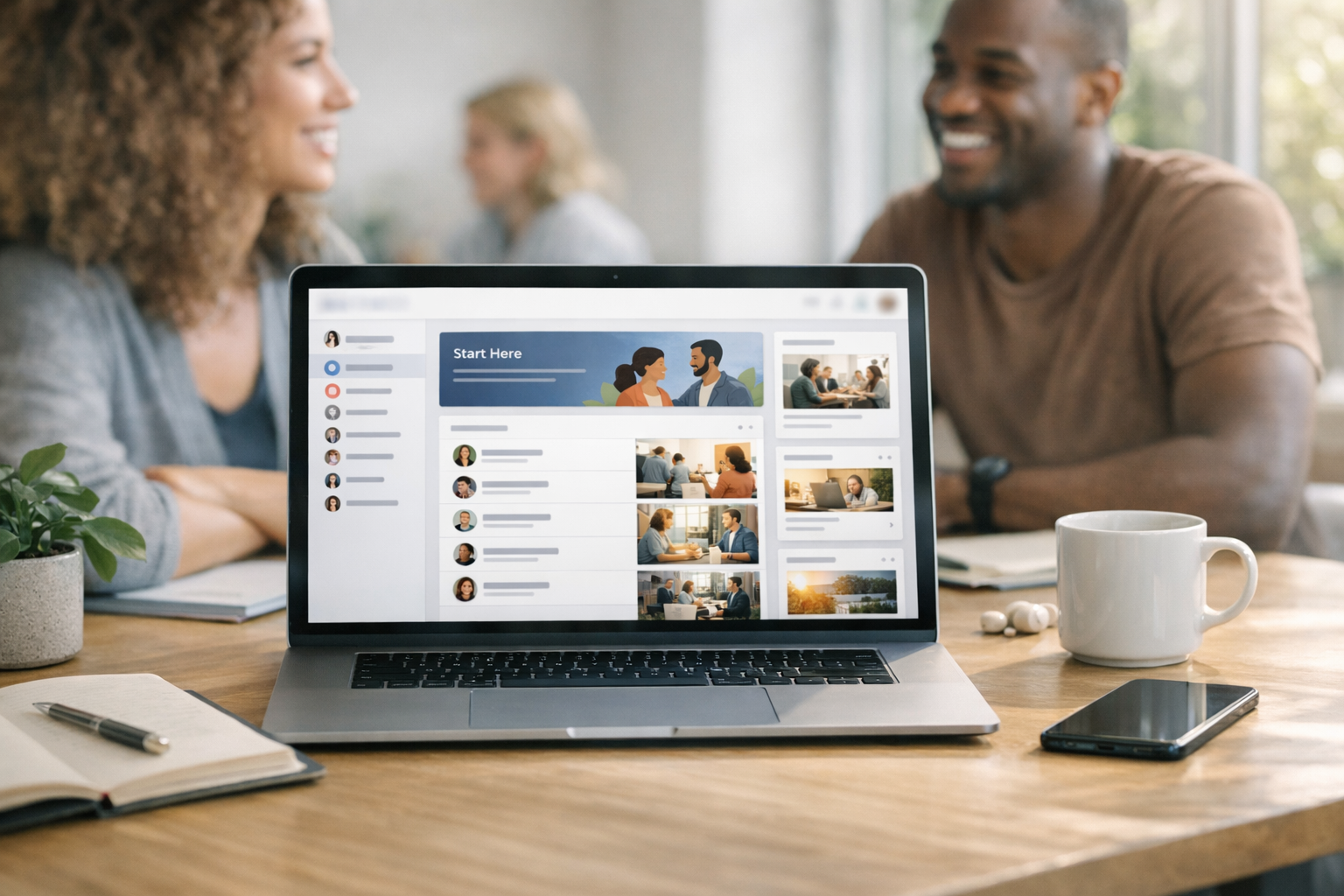
New members shouldn’t wonder what to do next. This guide shows community leaders how to build a “Start Here” Welcome Hub that accelerates community onboarding and lifts activation rate in the first 7 days—whether you’re running a Discord onboarding flow, a Slack onboarding sequence, or a Circle community space.
Every thriving online community shares a common trait: new members know exactly what to do when they arrive. Without clear member onboarding, newcomers feel lost, lurk silently, and eventually drift away. The solution? A persistent “Start Here” channel or Welcome Hub—a dedicated space that transforms confused visitors into confident, active participants who stick around.
👉 Get the free Welcome Hub templates from Community Launcher to launch your onboarding in under an hour.
What Is a Community Welcome Hub?
A Community Welcome Hub is a single, always-accessible orientation point where every new member lands. Think of it as your community’s front door—a pinned resource that eliminates guesswork and replaces dozens of repetitive “how do I…” support questions each week.
Research consistently shows that a member’s first 72 hours determine whether they’ll become a long-term contributor or a ghost. A Welcome Hub shortens time-to-value, boosts member retention, and frees your community team to focus on meaningful connection instead of repetitive onboarding support.
The result? Higher engagement, faster activation, and compounding growth week over week.
What Should Be in a “Start Here” Channel?
Your Welcome Hub needs to be instantly digestible. New members won’t read a wall of text—they’ll scan for what’s relevant. Here’s a proven structure that works across platforms:
1. Welcome Message (2-3 sentences)
A warm, human greeting that confirms they’re in the right place. State who this community is for and the core benefit of participating.
2. Community Guidelines & Values
A brief section explaining what the community exists to do and how members are expected to treat each other. Keep your community guidelines to 3-5 bullet points maximum.
3. Quick-Start Actions
Three to five specific things a new member should do in their first session—introduce themselves, complete their profile, join a specific channel, or attend an upcoming event.
4. Navigation Guide
A simple map of your community’s spaces. Explain what happens where, so members can self-direct to the conversations that matter to them.
5. FAQ & Support
Address the five most common questions new members ask, and provide a clear path for getting help when they’re stuck.
The New Member Checklist: Your First-Week Onboarding Sequence
A new member checklist transforms passive reading into active participation. Design yours to guide members through progressively deeper engagement:
- Day 1: Read community guidelines, complete profile, post an introduction
- Day 2: React to or comment on an existing discussion
- Day 3: Join one interest-based channel or group
- Day 5: Attend a live event or watch a recorded session
- Day 7: Start a new conversation or help another member
This graduated approach prevents overwhelm while building the habit of returning daily. It’s the single most effective lever for improving your activation rate and 30-day member retention.
Need a plug-and-play version? Download the Community Launcher new member checklist template and customize it for your platform in minutes.
How Do I Build a Welcome Hub on Discord, Slack, or Circle?
The core principles apply across every platform, but implementation details differ:
Discord Onboarding
Use a locked “Start Here” channel at the top of your channel list. Combine pinned messages with Discord’s built-in onboarding features (Server Guide, customization questions) to route members into relevant channels automatically.
Slack Onboarding
Create a #start-here channel and set it as a default channel for all new members. Use Slack’s workflow builder to trigger a welcome DM with your checklist and link back to the hub.
Circle Community
Build a dedicated Welcome Space and set it as the landing page for new members. Circle’s space-locking features let you gate access to other areas until onboarding steps are complete.
Regardless of platform, the onboarding best practices remain the same: make your Welcome Hub impossible to miss, action-oriented, and up to date.
Onboarding Best Practices for UX
Make it persistent and findable. Pin your Welcome Hub in a prominent location. If members can’t find your “Start Here” channel within two clicks of joining, it’s buried too deep.
Use visual hierarchy. Break content into clearly labeled sections with headers, icons, and short paragraphs. Numbered steps outperform narrative text for action-oriented content.
Include multiple formats. Some people prefer reading, others prefer video. A short welcome video (under 90 seconds) alongside written content serves both preferences.
Update quarterly. A stale Welcome Hub erodes trust. Review it regularly to ensure links work, events are current, and the content reflects your community’s evolution.
Localization Considerations
If your community spans multiple languages or regions, don’t treat localization as an afterthought. Provide translated versions of your Welcome Hub for any language representing more than 10% of your membership. Assign regional hosts who can answer onboarding questions in members’ native languages, and consider timezone-specific event recommendations within your new member checklist.
Welcome Hub Templates & Tools
You don’t need to build your Welcome Hub from scratch. Community Launcher Welcome Hub templates offer proven frameworks specifically designed to help community builders create effective onboarding experiences across Discord, Slack, Circle, and custom platforms. Leveraging community onboarding templates means you can launch faster and iterate based on real member feedback rather than guesswork.
How Do I Measure Onboarding Success?
Track these metrics to gauge your Welcome Hub’s effectiveness:
- Activation rate: Percentage of new members who complete at least one checklist action within 7 days
- Support ticket volume: Reduction in repetitive “how do I…” questions after launch
- 30-day member retention: Whether oriented members stick around at higher rates than those who joined before the hub existed
If your activation rate sits below 40%, revisit your checklist—the actions may be too demanding or your hub may be too hard to find. If retention is flat, the problem likely lives beyond onboarding in your community’s ongoing value loop.
Frequently Asked Questions
What’s the difference between a Welcome Hub and community guidelines?
Community guidelines define rules and behavioral expectations. A Welcome Hub is broader—it includes your guidelines but also provides navigation, a new member checklist, quick-start actions, and support resources. Guidelines are one component of effective member onboarding, not the whole picture.
How long should a “Start Here” channel be?
Aim for content that takes under three minutes to read. If your Welcome Hub requires scrolling for more than a few seconds, break it into linked sub-pages or use expandable sections. The goal is to drive action, not comprehensive reading.
Can I automate my community onboarding?
Yes. Most platforms support automated welcome DMs, role assignment, and drip sequences. Pair your Welcome Hub with automated nudges that remind members of uncompleted checklist items on Days 2, 3, and 5.
How often should I update my Welcome Hub template?
Review quarterly at minimum. Update immediately when you add new spaces, change community guidelines, or shift your event schedule. A Welcome Hub with dead links or outdated information is worse than no hub at all.
Do I need a Welcome Hub for a small community?
Yes. Even communities with under 50 members benefit from clear onboarding. A Welcome Hub sets professional expectations early and scales with you—building the habit now saves significant rework later.
Final Thoughts
A Welcome Hub isn’t a “nice to have”—it’s infrastructure. It’s the difference between a community that constantly hemorrhages new members and one that compounds growth week over week. Start simple, launch quickly, and refine based on what your members actually need. The best Welcome Hub is the one that exists today, not the perfect one you’re still planning.
👉 Download the Community Launcher onboarding kit and ship your “Start Here” today.






Leave a Reply